Insights Artificial Intelligence
How travelers move from AI prompts to purchase decisions
Recruiting fraud is a growing issue for many companies.
The Trade Desk takes this issue seriously and is taking steps to address it.
Our platform
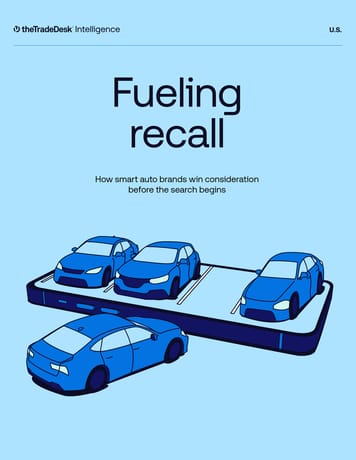
Auto brands’ biggest opportunity is in the priming stage, an extended period of time long before a buyer starts actively researching.
Share:
Auto brands’ biggest opportunity is in the priming stage, an extended period of time long before a buyer starts actively researching.
The moment a car buyer decides they are ready to buy a car, the most important marketing has already happened. In a webinar hosted by The Trade Desk Intelligence, “Priming Tomorrow’s Auto Buyers,” we revealed just how early brand consideration takes root, and just how much is at stake for auto marketers who wait too long to show up. The real battleground isn’t the bottom of the funnel, when buyers are ready to drive off the lot. It’s the months and years before a shopper is officially in-market — a phase we like to call the priming stage.
In an era of tightening consumer budgets, eroding brand loyalty, and an increasingly fragmented media landscape, the brands that win at the dealership are the ones that earned their place in consumer memory long before the search even began. Here are six insights for auto marketers to consider:
1. Consumer consideration sets are shrinking and forming earlier than ever
Buyers are narrowing their options sooner — these days, they have narrowed their options down to three instead of the previous five1 — making late-in-the-game breakthrough increasingly difficult for auto brands. While 86% of prospective buyers enter the purchase cycle undecided, two-thirds say they already have a mental shortlist before they start researching online.2 What that means for auto marketers is that there’s still room to influence, but only if you show up early and consistently enough. Brands that aren’t already familiar to a would-be buyer before their consideration set begins forming can risk being invisible by the time active shopping starts.
2. Brand consideration is built across three dimensions (and all three are crucial)
According to our research, brand consideration develops across three interconnected dimensions:
Situational (65% of prospective car buyers cited this as influential in their decision-making), driven by personal needs and life stage
Intrinsic (62% cited this as influential), built through long-term perceptions and personal experience
Cultural (51% cited this as influential), shaped by a brand’s presence in shared moments such as mass media and sporting events
Intrinsic consideration is the hardest to shift because it requires consistent exposure over a lifetime. But it carries weight with first-time buyers, who are 1.3 times more likely to have their consideration sets influenced by brands they grew up with compared to buyers purchasing their second or third car.
Situational and cultural dimensions are more immediately shapable through media. Brands can use these dimensions to speak to buyers with specific needs, such as those with families who may be looking for cars with extra storage space or safety features. And advertising during cultural or sporting events, or partnering with cultural entities, can bring brand awareness to new or younger audiences.
But it’s important not to put too much effort into one dimension at the expense of the others. Brands that show up across all three are more likely to surface naturally in the consideration set when a buyer is ready to act.
3. Connected TV is the strongest priming channel, outperforming walled gardens
Among all media channels studied, CTV stands alone as the most powerful priming vehicle: It is 1.5 times more persuasive than walled gardens during the priming phase. What makes it uniquely valuable is its versatility: CTV operates effectively across all three dimensions of brand consideration, functioning simultaneously as an emotional brand builder and a lower-funnel messaging vehicle. No other channel in our research spans that range, making CTV a must for any always-on media strategy aimed at building consideration before active car shopping begins.
4. Trust is a prerequisite, and the media buy plays a part
According to our research, 75% of consumers say they must trust a brand before they’ll seriously consider it, and where a brand advertises directly influences that trust. Premium, brand-safe placements on the open internet (including CTV and premium websites) signal credibility. Appearing alongside high-quality editorial content reinforces the same trustworthiness that brand-building campaigns work to establish over time. For auto marketers, media quality is a strategy that can either build or undermine a consumer’s trust, so they must choose wisely.
Report
5. The 60/40 framework is paramount for automakers
The effectiveness research is consistent: Brands that invest in both priming and activation can build stronger sales foundations than those that don’t. Brand and performance work best when they’re working together over time. That is, 60% of the budget should go toward long-term brand-building efforts, and 40% to shorter-term performance tactics aimed at buyers actively in-market. Brands that maintain that balance tend to see stronger ROI and healthier long-term growth.3
6. Connected identity enables a connected brand story
A priming strategy that spans channels and plays out over time only functions if the underlying data infrastructure supports it. Without connected identity, every channel resets the story. With it, impressions accumulate into familiarity and a long-term narrative. An identity approach designed for the open internet enables brands to tell a consistent story, from priming to purchase.
For auto marketers, the path forward is clear: The brands that show up consistently, across the right channels, with the right messages to the right people at the right time, and with the right data infrastructure to connect it all together, are the ones better positioned to earn a place on would-be buyers’ consideration list when they’re ready to act.
Sources:
1. The Trade Desk Intelligence and PA Consulting, The Automotive Report, November 2024.
2. The Trade Desk Intelligence and PA Consulting, Auto Priming Journey, U.S., n=1481 Auto Intenders in Next 12-Months, November 2025.
3. The Trade Desk Intelligence and Everyday People, The Case for Connecting the Funnel, September 2025.
Insights Artificial Intelligence
Insights Omnichannel
Insights Artificial Intelligence