Insights Data and measurement
How retail data is helping to deliver outsized returns across markets
Recruiting fraud is a growing issue for many companies.
The Trade Desk takes this issue seriously and is taking steps to address it.
Omnichannel
Holiday shopping research reveals that Americans are planning earlier and engaging across a broader mix of channels.

Share:
As marketers fine-tune their 2026 holiday media buys, consumer research from The Trade Desk Intelligence and Appinio indicates shoppers are looking into purchases earlier than ever, prioritizing Cyber Five deals, and discovering more products across the open internet.
Brands can help capture more demand and influence purchase decisions throughout the season by showing up early, leaning into value, and meeting consumers across premium environments.
The holiday shopping season now begins well before traditional peak periods.
Two in 5 people in the U.S. start researching purchases before Black Friday, and 38% say they go on to buy during that early window.2
Early shopping activity gives brands a chance to build awareness and shape consideration before competition swells.
Rather than focusing efforts solely on peak days, brands can benefit from maintaining a sustained presence throughout the season.
By using data to identify early intent signals, advertisers can engage people at the moments when they are most open to discovery.
Overall, holiday shoppers are most focused on:
Identifying practical products that fit everyday needs
Finding strong value across mid-priced items
Taking advantage of deals and discounts throughout the season
Together, these behaviors signal that value extends beyond price into usefulness, relevance, and reliability when making smart purchases.
For advertisers, messaging that emphasizes clear value and practical relevance can resonate most in a competitive holiday environment.
For the last holiday shopping season, 62% of people in the U.S. surveyed shopped online via non-Amazon or social channels.2 That’s also the percentage of time that gift-givers spend outside of social media, instead favoring media environments like connected TV (CTV), music, gaming, and editorial content.3 And get this: many gift givers engage media channels at higher rates during the holiday season2:
46% stream more with CTV
45% listen to more streaming music
27% engage more with podcasts
Meanwhile, e‑commerce continues to grow nearly 5 times faster than in-store sales, even as 79% of purchases still happen in physical retail.1 This signals a blended shopping experience, where digital channels drive discovery and consideration while in-store shopping captures demand.
For brands, success can come from connecting these touchpoints by building awareness online and converting interest into purchases.
Half of Americans say they purchase from both their go-to brands and new-to-them brands during the holidays, creating an opportunity for brands to win new customers while reinforcing existing relationships.2
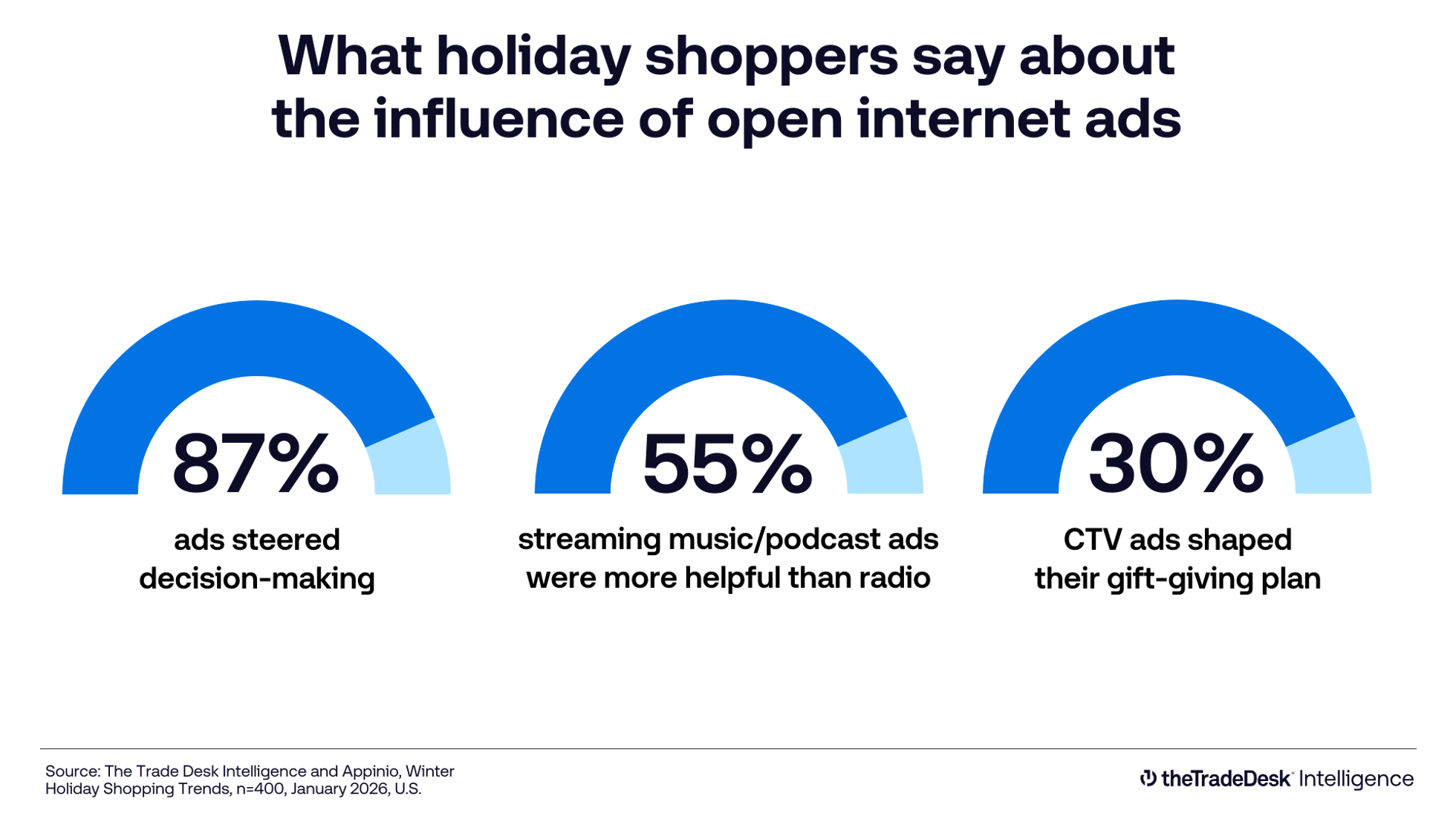
Advertising and promotional levers play a key role throughout this journey:2
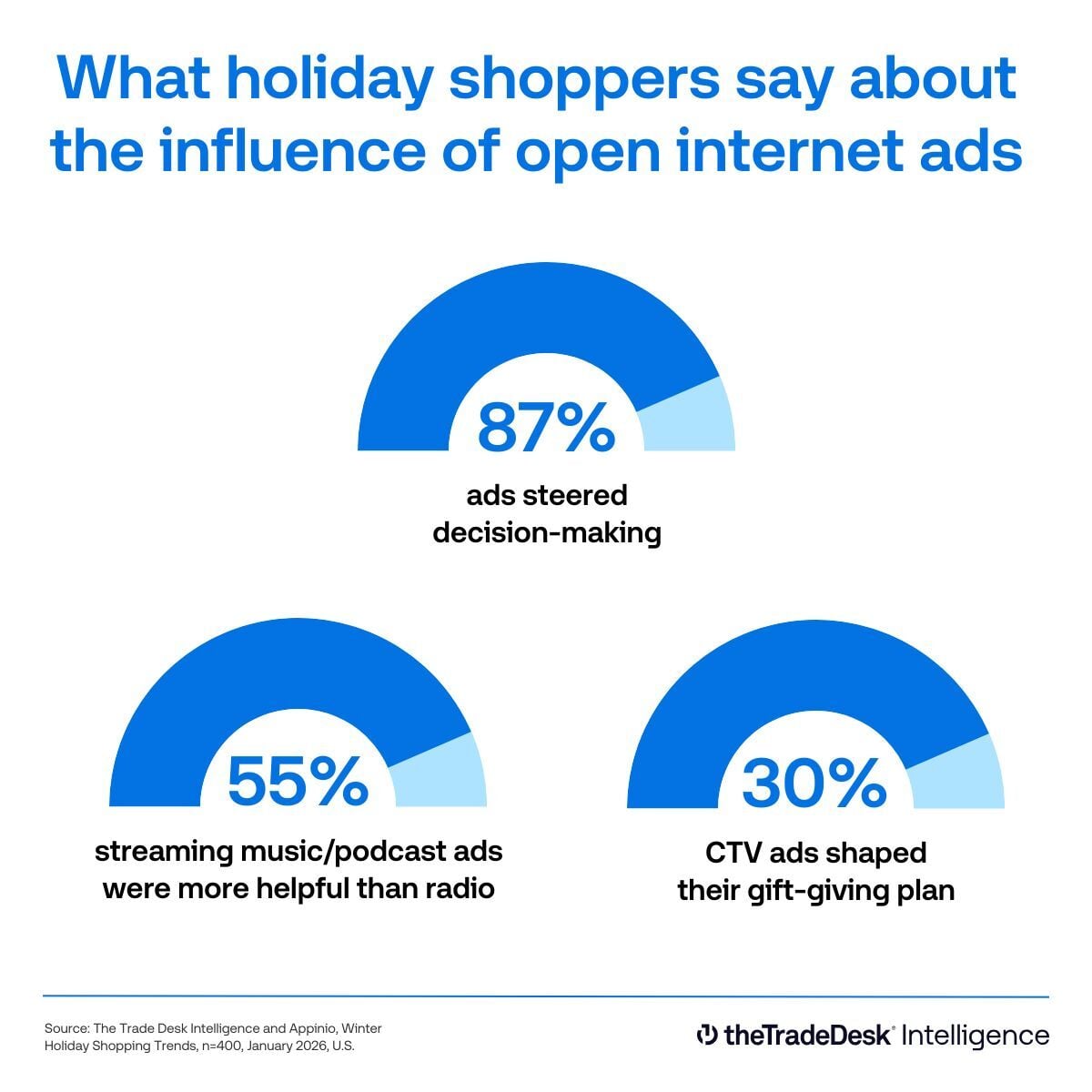
87% of shoppers surveyed say ads influenced their research and purchase decisions
31% say they’re swayed by discounts or holiday deals
32% agree that free or discounted shipping persuaded them to switch brands
30% credit CTV as part of their decision-making process
55% say streaming audio and podcast ads are more helpful for discovery than traditional radio
Coupling these findings with the amount of time shoppers spend on the open internet underscores why a diversified, omnichannel approach allows brands to stay present across these moments and helps consumers discover, compare, and ultimately choose products.
As media consumption increases across CTV, audio, and digital channels, these channels become critical touchpoints for influence.
According to The Trade Desk platform data, advertising holiday spend is growing and arriving earlier. Since 2023, advertiser spend is up 25% for Cyber Five — the five-day period between Thanksgiving and Cyber Monday.4 But the real shift is the ramp: the week before Thanksgiving now performs nearly as strong as the holiday itself. Brands building presence three to four weeks out are capturing that early momentum.
Media channel mix is shifting quickly too. CTV now takes 46% of Cyber Five spend, while audio grew 39% in 2025, faster than any other channel. And TTD platform insights show scale hasn’t gotten pricier either: impressions grew 39% since 2023 while CMPs held flat. The bigger savings come after peak, when CPMs run 14 – 27% below Thanksgiving-week levels just five weeks later, signaling an advantage for flexible campaigns.
The payoff for advertisers? Cyber Five lifted spending. Average spend per user rose 5% during Thanksgiving Week, and CPG brands saw a 29% jump, with most shoppers spending over $100 a day, according to consumer purchase data from Attain.5 Findings show 44% of Cyber Five activity is also cart-building, comparing, and waiting to buy,6 leaving substantial unconverted intent for retargeting to capture.
Holiday shopping is happening over a longer period and across more channels, giving brands more ways to reach shoppers throughout the journey.
While the majority of sales are still generated in store, e‑commerce is growing significantly faster, signaling where future momentum lies.
Brands that activate early, deliver value-driven messaging, and maintain a consistent presence across the open internet can help capture demand and drive stronger performance in the 2026 holiday season.
This information is provided solely for background and is not a representation or guarantee of any future performance.
Sources:
1. EMarketer Forecast, February 2026, U.S.
2 The Trade Desk Intelligence and Appinio, Winter Holiday Shopping Trends, n=400, January 2026, U.S.
3. Global Web Index (GWI), GWI Core Dataset, individuals who have bought a gift within the past month, Q1 – Q3 2025, U.S.
4. The Trade Desk platform data, Jan 2023 – Dec 2025.
5. Attain, Nov 20 – 27, 2025.
6. Datacy.com AI, 10K Cyber 5 consumer interactions, Oct 1 – Dec 1, 2025.
Insights Data and measurement
Insights Omnichannel
Insights Retail Media