Clarify the outcome you’re measuring
• Identify the primary business KPI
• Align campaign metrics to that outcome
• Separate delivery metrics from effectiveness metrics
Recruiting fraud is a growing issue for many companies.
The Trade Desk takes this issue seriously and is taking steps to address it.
Data and measurement
When using the right tools, measurement can become a marketer’s competitive advantage, creating a flywheel of campaign optimization and insights. This guide outlines the principles of effective measurement and offers practical ways traders can use new tools available on The Trade Desk platform to connect media investment to business outcomes.
Share:
When executed well, measurement creates a flywheel that can help optimize campaigns in real time, illuminate consumer behavior, and connect marketing tactics to business outcomes.
When marketers understand what’s working, they can optimize for it, making campaigns more successful over time. However, when measurement breaks down, the flywheel slows.
Measurement can falter for many reasons, like fragmentation between channels or incomplete datasets. When a media mix grows harder to measure, you may be forced to optimize toward what’s easiest to measure, like the last click.
As a result of these dynamics, marketers are feeling dissatisfied with their measurement solutions. Sixty percent to 75% surveyed say advanced measurement tools fall short in rigor, coverage, timeliness, trust, and efficiency needed to assess ROI.1
In this guide, you’ll learn how to approach measurement so it can help effectively connect your cross-channel media spend to real business outcomes, rather than relying on proxy metrics like clicks and reach.
Good measurement starts with clear principles. An effective measurement strategy is grounded in:
Strong signals at every stage of the funnel
Transparent performance across media channels
Actionable insights surfaced throughout the campaign
Continuous experimentation to understand what’s really working
When these four principles guide the strategy, measurement can become a genuine competitive advantage.
Measurement quality depends on signal quality. The strongest signals come directly from your business (or relevant data providers) and apply to every stage of the funnel:
Awareness
Incremental reach and frequency reporting
Brand lift studies
Consideration
Site or app behaviors, like page views or form fills
Store visitation and foot traffic insights
Conversion
Purchase data from retailers and direct sales
Customer relationship management (CRM) records
Incremental conversion lift analysis
These inputs help establish a link between media exposure and business results. The Kokai platform offers a number of tools to help enrich measurement with high-quality signals:
A marketplace of measurement partners at every stage of the funnel and across different advertiser verticals (brand lift, footfall, and sales), including retail measurement partners that cover 81% of retail sales in the U.S.
First‑party data onboarding and activation using clean room and data platform partnerships, pixels, and/or APIs
Unified ID 2.0 (UID2) for durable identity interoperability and a robust cross-device graph

“The identity framework used for targeting should always match the one used for measurement. Because when identity and measurement are siloed, attribution tends to break down. When they’re aligned, you can connect impressions, audiences, and conversions across the full customer journey.”
— Taha Dharamsi, Senior Trading Specialist, The Trade Desk
Strong signals enable:
Better linkage between media and revenue
More reliable upper- and lower-funnel insights
Stronger predictive models
Measurement starts with the signals you trust most.
If you can’t see how media performs across media channels and environments, you’re limited in what you can optimize. Measurement should reveal a great deal of information about how a campaign performed, including:
Where ads appeared (channel and site)
Who they reached and how frequently
Which exposures influenced behavior
Without this visibility across the path to conversion, it becomes difficult to diagnose common performance issues such as audience over-frequency, underperforming publishers, and ineffective creatives.
Modern measurement frameworks provide visibility across channels with holistic path-to-conversion reporting and cross-channel insights.
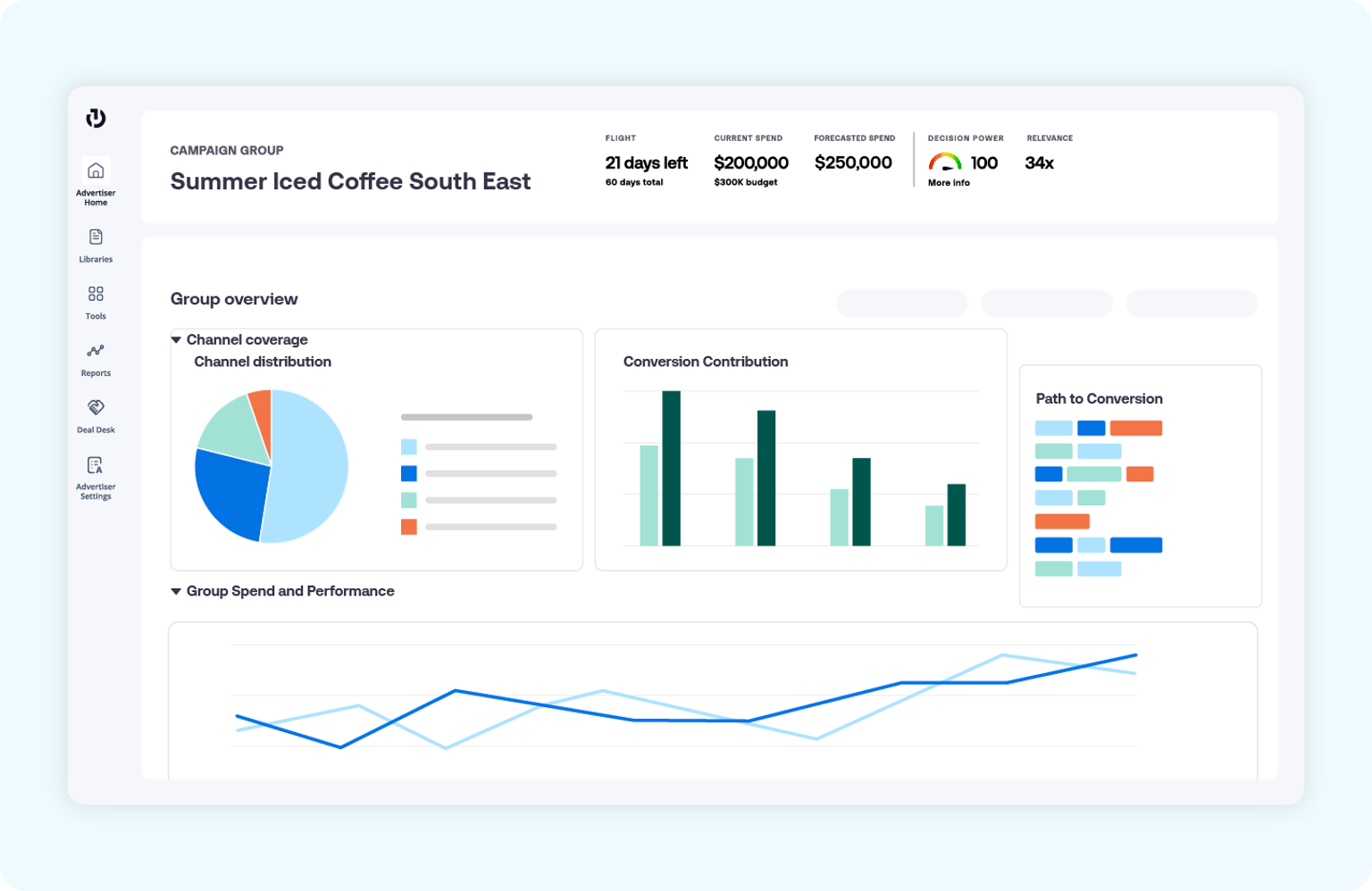
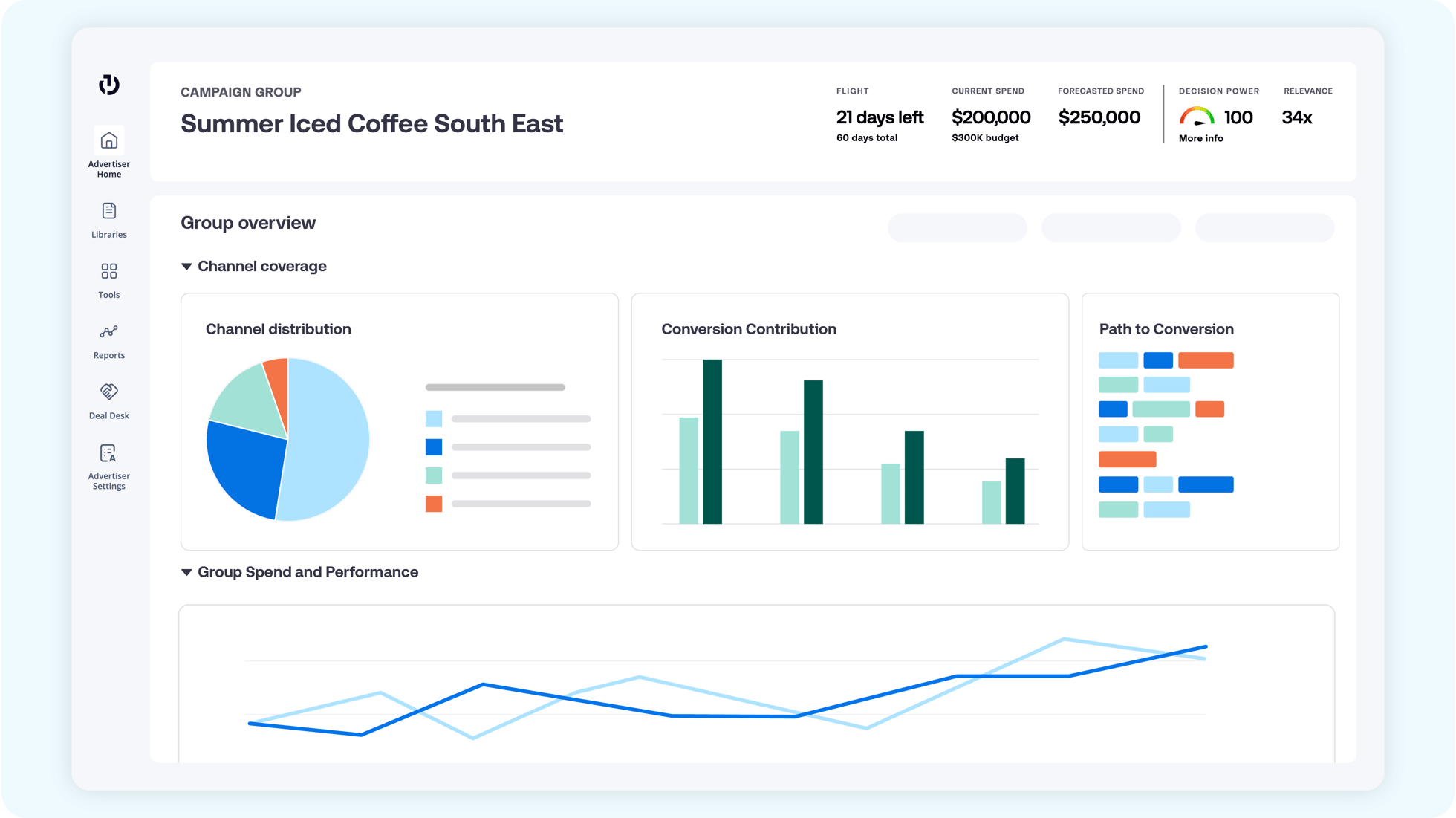
On our platform, you can see the entire path from impression to outcome, and optimization becomes significantly more precise. You can also uncover new insights into who your customers are and where and when they engage with your brand.
In-flight measurement is incredibly valuable, as it can create a feedback loop that allows you to learn and optimize in real time.
Instead of waiting for post-campaign reports, you can do the following on the platform:
Identify which audiences drive conversions
Evaluate publisher performance within a channel
Reallocate budget dynamically
For example, you might:
Test different audience segments to see which generates higher conversion rates
Adjust frequency caps when diminishing returns appear
Shift spend toward channels driving stronger incremental outcomes
Refine audience construction using performance signals

Our platform
To enhance the campaign’s performance, the team optimized their creatives mid-flight into high-impact formats tailored to different audiences.
When insight arrives quickly enough to influence decisions, measurement becomes an operational advantage.
No single methodology can answer every measurement question. For example, last-click attribution may provide a signal to use as a baseline, but it doesn’t show the whole picture of the audience journey or what actually caused someone to convert. Modern measurement works best as a portfolio of complementary approaches, including:
Brand lift studies
Incrementality testing
Marketing mix modeling (MMM)
Each approach provides a different perspective.
Brand lift helps measure upper-funnel impact
Incrementality tests reveal causal effects
MMMs provide a holistic view across channels and platforms
The goal is to build a framework that reflects your business’s unique needs. When you combine multiple measurement approaches, you can gain a clearer understanding of which media investments create impact.
You can use this checklist to help you evaluate and improve your measurement approach.
• Identify the primary business KPI
• Align campaign metrics to that outcome
• Separate delivery metrics from effectiveness metrics
• Confirm which first-party signals are available
• Evaluate the quality and volume of conversion events
• Identify gaps where additional signals (e.g., retail data) could improve accuracy
• Review placement-level visibility across campaigns
• Evaluate frequency distribution across audiences
• Identify underperforming publishers or segments
• Define one or two testable hypotheses per campaign
• Run controlled tests to validate assumptions
• Use findings to inform the next round of optimization
The most effective traders treat measurement as an evolving system built on strong signals, transparent insights, and continuous experimentation.
When those fundamentals are in place, every campaign becomes an opportunity to learn, refine, and improve how media investment drives real outcomes.
For more information about how to move beyond last click and put the Kokai platform’s measurement solutions to work on your next campaign, contact your representative today.
Not yet working with The Trade Desk? Contact us using the form below.
This information is provided solely for background and is not a representation or guarantee of any future performance.
Source:
1. Gartner 2025 CMO Spend Survey. Base: Incrementality test regular users (n=292); Attribution users (n=315); MMM users (n=287). Source: IAB/BWG Strategy, 2026.
Resources Connected TV
Resources Our platform

Resources Our platform